


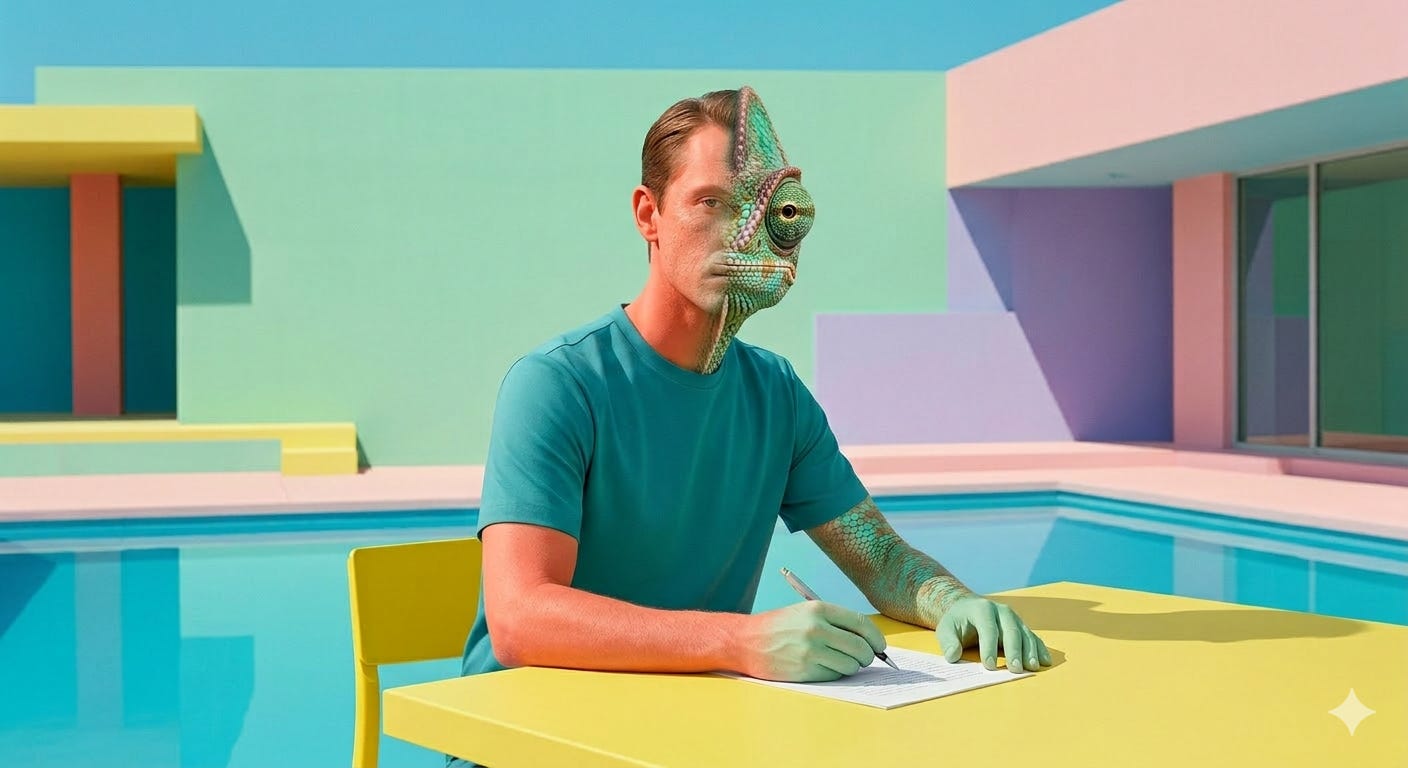
I am aware that the text below is quite intense and maybe not that enjoyable to read for some of you. Because of that, I made a comprehensive video which you can find at the end of the text. The video is not perfect but brings across the main arguments of my text quite well.
Thank you for sticking around and enjoy the read.
The world I see is governed by cause and effect. Every event is the result of the events that came before it. If we accept this deterministic view, we must also accept that for any clearly defined goal, there exists a single, mathematically superior next move at any given moment. This optimal move is not a matter of opinion. It is a physical reality dictated by the current state of all matter and energy. However, for the vast majority of goals, the challenge stems from the fact that while an optimal move exists, no individual possesses enough information to see it.
The core of this worldview lies in the distinction between the universal optimum and the personal optimum. The universal optimum is the move that would be made by an individual with total knowledge of every variable in existence. In contrast, the personal optimum is the best possible move an individual can make based on the limited information they currently possess.
Because we are finite beings, we are permanently separated from the universal optimum. We operate in a state of partial blindness, making choices based on a small fraction of the total information. This means that even when we make the most logical choice possible, it may still lead to failure because of unknown unknowns, which are factors that were physically real but hidden from our view.
Within this worldview, learning serves as the bridge between our limited perspective and the hidden reality of the universe. It is the deterministic mechanism by which an individual upgrades their internal models of cause and effect. Learning does not change the universal optimum directly, but it fundamentally alters the personal optimum. By acquiring new information and refining our logic, we become less ignorant. Every time we learn, we are reducing the total amount of information we are missing, allowing our personal decisions to align more closely with the reality of the universe. Without learning, an individual is stagnant, with it, they become a more accurate processor of reality.
Personal goals are the inevitable result of an individual’s total history. Biology, experience, and environment converge to create a specific trajectory. A goal is simply the manifestation of who a person is. Because the self generates the goal, it also defines the optimal path and the constraints that shape it. While no two people share the same history or optimal path, different individuals can still arrive at the exact same best next move.
The search for the best next move is complicated by the fact that both the individual and the universe are in a state of constant change. Information gathering and learning are essential for narrowing the gap between the personal and universal optimum, but they are not free resources. They cost time, and time means change. As time passes, the optimal move changes. A move that was perfect a moment ago may become useless as the environment shifts. Furthermore, as an individual learns and gathers more information, they themselves change. This internal change can shift the goal itself. Consequently, the true optimal move is a balance: it is the choice that uses enough information but happens quickly enough to be relevant. Waiting for perfect certainty is, in itself, a sub-optimal move because it ignores the reality of time.
This worldview redefines the quality of human decision-making by anchoring judgment to the outcome. In a deterministic universe, the value of a decision is validated by its results. Because success and failure are physical facts, good judgment is defined as the identification and execution of a personal optimum that successfully reaches the intended goal. It does not require alignment with the universal optimum, as a move can be effective without being the best move in existence.
A move that fails to reach the goal is, by definition, bad judgment. Such a failure represents a disconnect between the individual’s internal model and the physical reality of the situation. This occurs when the personal optimum fails to account for the deterministic nature of the world, whether through flawed logic, insufficient information, or an inability to act within the constraints of time. In this context, judgment is a technical evaluation of reliability. Consistent success demonstrates that an individual’s internal processor is calibrated to reality, while failure proves a lack of calibration.